
Poster at PaPE
Poster at today’s PaPE:
Wagner, M. and McAuliffe, M. (2017). Three dimensions of sentence prosody and their (non-)interactions. Poster presentation at Phonetics and Phonology in Europe 2017, Universität Köln. [poster]
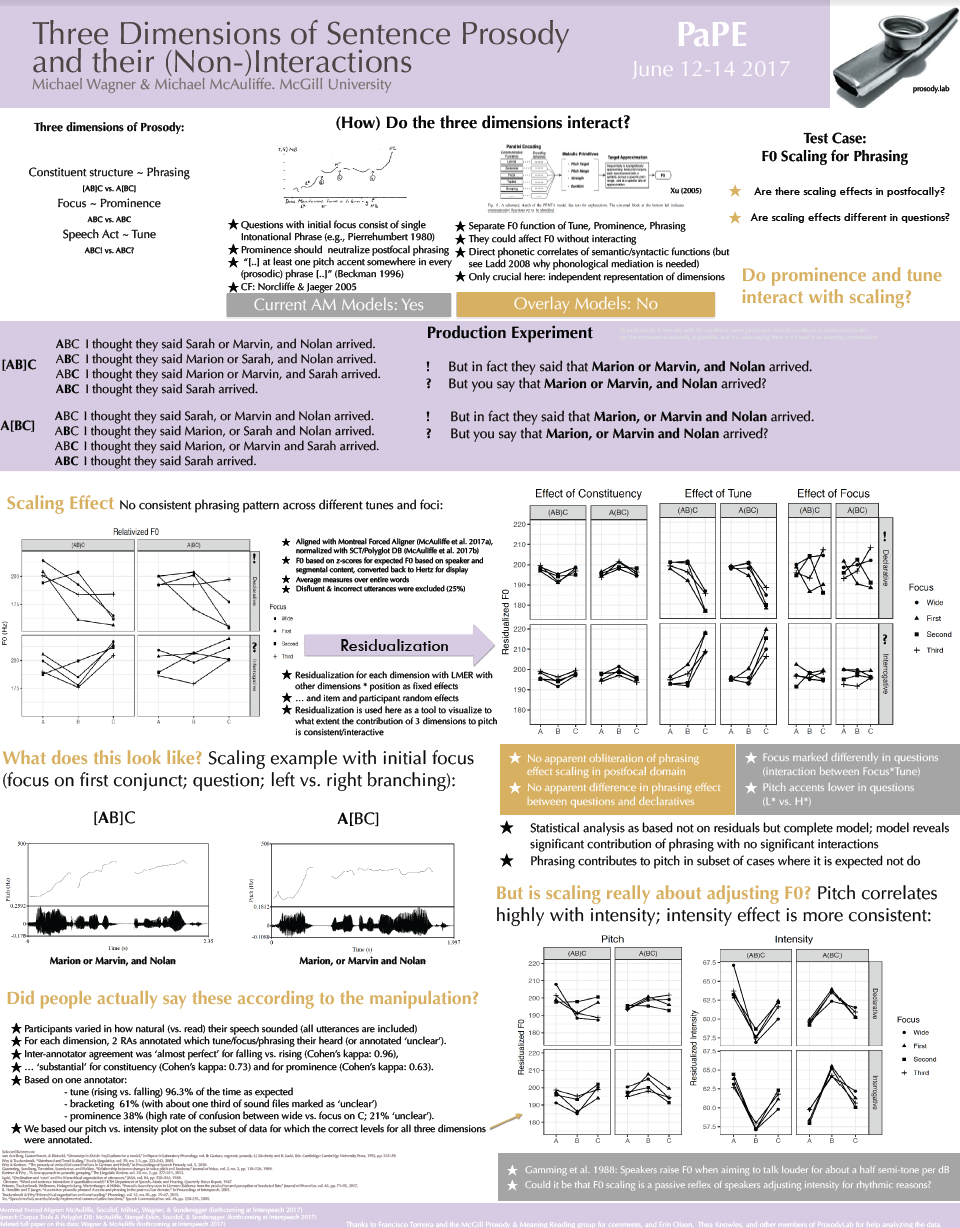
Poster at today’s PaPE:
Wagner, M. and McAuliffe, M. (2017). Three dimensions of sentence prosody and their (non-)interactions. Poster presentation at Phonetics and Phonology in Europe 2017, Universität Köln. [poster]
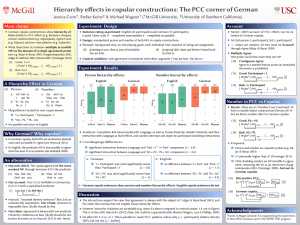
Why you can’t say this in German (or at least it won’t sound great):
Coon, Jessica, Stefan Keine, & Michael Wagner (2016): Hierarchy effects in copular constructions: ThePCC corner of German. Poster presented at NELS 47, UMass Amherst.
A while ago, I posted on two competing meanings of ‘frown’ here. Just recently, Lynne Murphy at separated by a common language followed up on this with this post, which generated some interesting responses.
Most spectacularly, it prompted the following confirmation that British vs. American English distinction indeed has something to do with it (even though I didn’t find consistent intuitions among the (few) people from the two sides of Atlantic that I informally asked about it at the time): Josef Fruehwald observed the following amazing difference in the the respective sign languages (British vs. American) on Twitter:
http://bslsignbank.ucl.ac.uk/media/bsl-video/MI/MISERABLE.mp4
vs.
this.
The earliest reference someone posted in the comments section of the downward-facing smile reading so far dates to the 1930s–any earlier occurrences anyone?
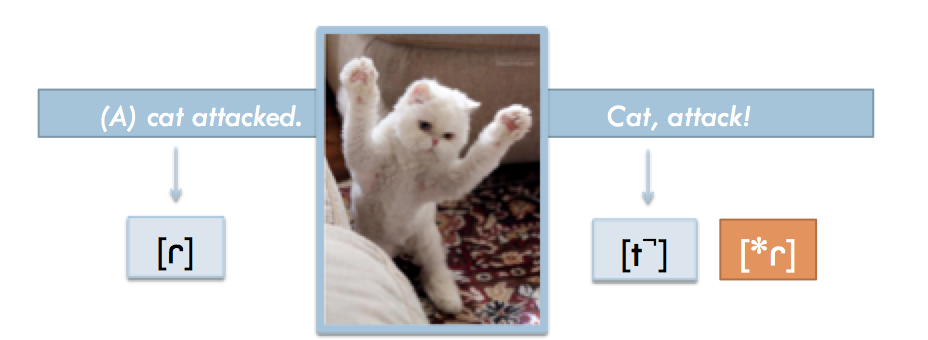
Oriana Kilbourn-Ceron, Michael Wagner and Meghan Clayards: Locality and variability in cross-word alternations: a production planning account. Poster at Labphon 15 at Cornell. [abstract]
Alanah McKillen just finished her Dissertation On the interpretation of reflexive pronouns. You can read it on lingbuzz.
Tomorrow, at 10.30 at WCCFL in Utah:
Liz Smeets, Michael Wagner (McGill): The syntax of focus association in German/Dutch: evidence from scope reconstruction
Last week we presented a paper on flapping and production planning at CLS:
Oriana Kilbourn-Ceron, Michael Wagner & Meghan Clayards (McGill University) The effect of production planning locality on external sandhi: A study in /t/
*> *The intervocalic flapping of English coronal stops /t, d/ is nearly categorical when the VTV sequence is within a word but variable when a word boundary intervenes, and occurs only rarely across a large boundary such as a clause edge. This is pattern cross-linguistically common in external sandhi — but why are segmental processes at word edges often more variable, and what influences the rate of variability? Previous literature on phonological variability has proposed that phonological rules make reference to syntactic structure or that phonological process are tied to prosodic domains. In contrast, we propose that phonological variability is only indirectly influenced by syntax and prosody through the locality of production planning. This hypothesis is motivated by psycholinguistic models of speech production, and we test its predictions for English flapping in a corpus study and a production experiment. Results show that syntax may have an effect above and beyond prosodic boundary strength, and that the lexical frequency of the following word has a significant influence on rate of flapping, consistent with the LPP hypothesis.**
This summer, McGill’s prosodylab will be represented at the DGFS summer school in Tübingen on Mapping Meaning: Theory - Cognition - Variation, which is held August 15th - 26th, 2016 in Tübingen/Germany. Early bird registration is open until June 1st.

The course is titled Prosody and Incremental Processing, an abstract is posted here.
Check out tomorrow’s prosodylab poster at NELS 46 at Concordia:

Daniel Goodhue, Lyana Harrison, Yuen Tung Clémentine Su, and Michael Wagner (2015). Toward a bestiary of English intonational tunes. Poster at the 46th Conference of the North Eastern Linguistic Society, at Concordia University, in Montréal. [abstract] [poster] [items.]
If you want to know about the project and want to listen to the data, have a look here.
Contact us if you’d like to learn more, or want to suggest other annotations or ways to analyze this data. You can also annotate it yourself if you want.
We posted a new paper on relative clause extraposition in German on the semantics archive:
More …